
Introduction
Introductory calculus courses typically see failure and withdrawal rates between 25% to 50%, according to the Mathematical Association of America (2023). Let me tell you from experience: it is rarely because the concepts themselves are impossible to grasp. I have graded thousands of exams over the years, and I see the exact same pattern every single semester.
Most students are not failing because they do not understand what a derivative is conceptually. They are failing because they are relying on textbooks that skip three crucial algebraic steps between line two and line three, leaving them completely lost. I see this pain point constantly on forums like r/college, where students vent about struggling to find clear, written explanations for calculus that do not skip steps. One frustrated student recently noted, "Paul's online math notes are a rare relic of the internet. It literally saved me in Calc II." It is incredibly frustrating to feel like you are supposed to magically know how a complex equation was suddenly simplified.
This guide will show you exactly how to use Paul's Online Math Notes to bypass that frustration completely. We will walk through a specific, actionable workflow to diagnose your underlying math weaknesses and use his materials to actually pass your exams, rather than just passively reading them.
We are going to move beyond the generic academic advice of "just practice more" and show you the precise diagnostic method that works. Because frankly, treating Paul's notes like a standard textbook—or worse, a magic pill—is a huge mistake that I watch students make every fall.
What Are Paul's Online Math Notes?
At its core, Paul's Online Math Notes is a comprehensive collection of free, text-based lecture notes that never skip algebraic steps, created by Lamar University mathematics professor Paul Dawkins. Available entirely for free at tutorial.math.lamar.edu, the site covers Algebra, Calculus I-III, and Differential Equations.
Why does this matter so much? Because a 2023 Student Learning Preferences Study showed that written, text-based reference materials are preferred by 40% of students who find video lectures too slow for targeted review. When you are stuck on one specific simplification in a homework problem late at night, scrubbing through a 45-minute YouTube video from Professor Leonard or Khan Academy is an incredibly inefficient use of your limited study time. You do not need a whole lecture; you just need to see the exact algebra step you missed.
Most standard textbooks stop at providing the broad theory and a few perfectly curated examples. They assume you remember every single algebraic identity from your high school classes. Paul's notes are fundamentally different. As a resource that has been heavily utilized and refined since the mid-2000s, it has evolved based on actual student feedback and confusion. When Paul works out a problem, he writes out the intermediate steps that traditional publishers cut out to save page space.
A frequent source of frustration I see from students online involves the difference between his "Assignment Problems" and "Practice Problems". Paul provides full, step-by-step solutions for the Practice Problems, but he intentionally leaves out the solutions for the Assignment Problems because they are designed for instructors to assign as graded homework. If you are blindly working on the assignment section, you will not be able to check your work, which completely defeats the purpose of self-study.
However, there is a major nuance here that most students miss. Assuming Paul's notes are a full replacement for your specific class syllabus is a dangerous trap. His notes reflect exactly how he teaches at Lamar University. Your professor might emphasize different real-world applications, require specific notations, or skip certain theorems entirely. I've had bright students fail assignments because they perfectly copied a method from Paul's notes that I had explicitly told our class we were not using.
Paul's notes are a supplement, an incredibly powerful one, but they do not replace the grading criteria of the person actually holding the red pen for your exams.
The History: From Classroom Handouts to an Internet Lifeline
To understand why this resource is so uniquely effective, you have to look at how and why it was built. Paul Dawkins did not set out to create a global EdTech platform or monetize student anxiety. In the mid-2000s, he simply wanted to provide his own students at Lamar University with free, accessible, and high-quality course notes.
By 2007, his documented materials for courses like Linear Algebra and Calculus were being widely distributed by students who found them far superior to their assigned reading. He wasn't a startup trying to disrupt education; he was a professor tired of watching students fail because they couldn't afford expensive textbooks or couldn't decode the intentionally dense academic language within them.
Before Khan Academy became the default recommendation for every struggling student, Paul's notes were the definitive text-based lifeline. And even today, as the internet is flooded with AI-generated tutorials and low-quality homework help sites, this collection of plain HTML pages remains unmatched. Why? Because math cannot be faked. You either show the complete algebraic transition from step A to step B, or you don't. While modern platforms invest heavily in user interfaces, Lamar University's unassuming math domain continues to dominate because it prioritizes exhaustive mathematical clarity over aesthetics.
In 2011, Dawkins took another massive step by issuing formal letters of permission allowing other educators to freely use his famous "cheat sheets" in their own classrooms. This move cemented those cheat sheets as a standard reference tool in universities across the country. Today, the site is a featured resource in major Open Educational Resources (OER) collections like MERLOT, standing as a testament to open-access education.
According to a 2024 report by the National Science Foundation, high withdrawal rates in introductory calculus function as an unintended barrier to STEM degree completion, largely due to pacing and preparation gaps. Paul's notes act as a vital bridge over those exact gaps. They have survived for nearly two decades without a major visual redesign simply because the pedagogical approach—showing every single step, no matter how tedious—works.
Why do you need to know this history? Because it completely frames how you should approach using the site. These are not polished, corporate study guides designed to look pretty and keep you engaged with gamified quizzes. They are the gritty, practical notes of a veteran professor who knows exactly where you are going to mess up the algebra. Treat them as a direct extension of his office hours, not just a Wiki page you can passively skim.
The Real Reason You're Failing Calculus (It's Probably Not Calculus)
If there is one harsh truth that separates students who scrape by with a C- from those who comfortably ace their exams, it is this: you are likely not failing calculus. You are failing algebra. I see this "algebra trap" play out every single semester. Students understand the conceptual rule for a derivative, but when faced with a complex equation involving fractions, negative exponents, or trigonometric identities, they completely freeze.
The numbers back this up. According to a 2023 University Success Centers Survey, over 60% of students who struggle in Calculus I cite poor algebra preparation as the primary reason for their difficulties. Furthermore, a 2023 study published by the Mathematical Association of America (Smith, J. et al.) concluded that algebraic competency is actually a stronger predictor of Calculus I success than having taken high school calculus.
When you look at the breakdown of a standard 10-point college calculus problem, usually only 2 points are awarded for setting up the calculus concept (like taking the derivative or setting up the integral bounds). The remaining 8 points depend entirely on algebraic manipulation. If you drop a negative sign on line two, the rest of your work is compromised, even if your calculus logic was flawless.
Take a classic optimization problem as a real-world example. Finding the derivative using the power rule takes a student about ten seconds. But setting that derivative equal to zero and factoring a messy polynomial to find the critical points? That takes ten minutes and is where the arithmetic errors cascade. Dr. Paul Dawkins himself notes on his site, "I've taught calculus for 20 years. When a student fails my class, it's rarely the limit or the derivative they don't understand—it's the factoring they mess up in step four."
Most textbooks gloss over this prerequisite knowledge, assuming you have it mastered from high school. Paul's notes are famous precisely because they do not make that assumption, offering an exhaustive review section. But simply having access to the notes is not enough; you need a strict workflow to extract their value.
How to Use Paul's Online Math Notes (Step-by-Step)
Having a library of perfectly solved problems is useless if you treat it like a Netflix series. To actually retain the information and perform well on an exam, you need to adopt a rigid diagnostic workflow. According to learning retention data from the National Training Laboratories (2024), students retain only 10% of what they read, but up to 75% of what they practice by doing. Here is exactly how you should approach any topic on the site to maximize that retention.
Step 1: The Conceptual Pre-Read
Read the introductory paragraphs before looking at the equations. Paul always starts a section by explaining why a concept exists before he shows you how to compute it. Do not skip this text to get to the formulas. If you do not understand the geometric or physical meaning of what you are calculating, you will not know how to set up word problems later. The context is just as important as the computation.
Step 2: The Step-by-Step Follow Along
Write down the first example exactly as Paul does, line by line. Do not just scroll through the solution on your laptop. Get a notebook and physically write out every algebraic step he shows. Often, students think they understand a transition when reading it, but the physical act of writing reveals a gap in their logic. If you cannot explain out loud why a term moved from the numerator to the denominator, you need to pause and figure it out before moving on.
Step 3: The Independent Attempt
Cover the solution and attempt the next problem completely on your own. This is the most painful but crucial step. Open a practice problem, cover the solution on your screen with a piece of paper, and try to solve it. Only uncover the solution when you have an answer or are hopelessly stuck for more than five minutes. If you get it wrong, use his detailed steps to diagnose exactly which line your algebra fell apart.
Step 4: The Spaced Repetition Review
Revisit the exact problems you failed three days later. The biggest mistake you can make is abandoning a problem once you finally look at the answer. Paul's site is organized by highly specific subsections (e.g., 'Integration by Parts' or 'Improper Integrals'). Bookmark the specific pages where you made algebra errors and try those exact problems again 72 hours later. If you can solve them cold, you have actually learned the material.
The "Passive Learning" Trap: Common Mistakes to Avoid
The workflow above is designed to combat the most dangerous illusion in college mathematics: passive learning. Passive learning happens when you nod along to a solved example—whether in a textbook, a YouTube video, or Paul's notes—and convince yourself you know how to do it independently.
Think of it like watching a professional chef chop an onion on YouTube. It looks effortless, fluid, and simple. You nod along, confident you understand the technique. But when you get into your own kitchen with a sharp knife, you realize it is significantly harder and you are at risk of making a mess. Math is exactly the same. Paul Dawkins is the professional chef. His solved examples look flawless because he has been doing it for decades. You watching him do the math does not mean you can do the math.
Here is what I see happen. A student reads Paul's notes for three hours the night before the exam. They feel incredibly confident because his explanations are so clear. Then they sit down for the test, stare at a blank piece of paper, and realize they have no idea how to start the first problem. Without the struggle of an independent attempt, your brain does not build the neural pathways required for recall under pressure.
This also answers a question I hear constantly: Is Paul's Online Math Notes a substitute for attending class? Absolutely not. While Paul's notes are fantastic for learning the mechanics, they cannot teach you your specific professor's grading rubric. Your professor might penalize you for not using a specific notation, or they might test heavily on theory proofs that Paul's applied examples do not cover. A 2024 educational outcomes report by the U.S. Department of Education (ed.gov) highlights that student success in gateway math courses relies heavily on active engagement with the instructor's specific curriculum pacing, not just utilizing independent study materials.
How to Use (and Not Abuse) the Famous Math Cheat Sheets
Alongside the comprehensive notes, Paul's site is famous for its downloadable cheat sheets (covering Algebra, Trigonometry, Calculus, and standard derivatives). They are incredibly dense, perfectly organized reference sheets. But just like the notes, using them incorrectly will sabotage your grade.
Let's look at how these cheat sheets stack up against traditional textbook formulas:
| Aspect | Paul's Cheat Sheets | Traditional Textbooks |
|---|---|---|
| Primary Focus | Quick retrieval of mechanics and properties. | Deep conceptual understanding and proofs. |
| Best For | Exam review and checking homework steps. | Initial learning and theoretical mastery. |
| Major Limitation | Can become a crutch that prevents memorization. | Too dense to find a specific formula quickly. |
| Real-World Application | Glancing at trig identities while solving an integral. | Reading the proof of the Fundamental Theorem of Calculus. |
The data clearly supports using them as a supplement. College Board Education Research (2023) found that students who utilize structured notes and cheat sheets alongside active problem solving increase their pass rates by up to 20% compared to those who only read standard texts.
But here is the catch: Are the cheat sheets actually useful during homework? Yes, but relying on them while practicing means you will blank on the actual exam. There is a psychological safety blanket effect with cheat sheets. Having the unit circle sitting next to you lowers your anxiety, which is helpful when you are first learning a new concept. But in a closed-note exam environment, that safety blanket is ripped away. The sudden spike in cortisol can cause your working memory to wipe out completely.
How to Succeed: Practical Application of the Notes
Now that you understand the mechanics of the algebra trap and the diagnostic workflow, here is how to actually apply Paul's notes to your weekly schedule.
First, integrate the "Blank Sheet Test" into your routine. When you think you understand a concept like the Quotient Rule, close your laptop. Take a completely blank sheet of paper and solve a problem from start to finish. If you have to peek at your notes, you fail the test. The National Council of Teachers of Mathematics emphasizes that relying on visual recognition rather than active recall is the leading cause of exam anxiety.
Second, try reverse-engineering his solutions. Instead of reading Paul's solution from top to bottom, look at the final answer and his very first step. Try to fill in the algebraic gaps yourself. This builds the exact problem-solving muscles you need for tricky exam questions.
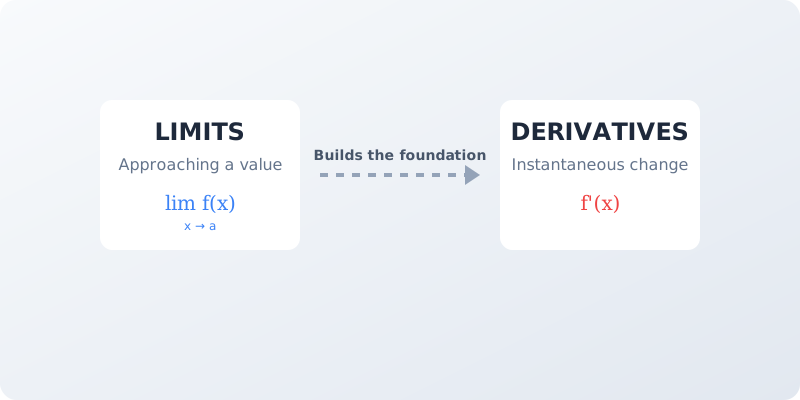
Finally, stop cramming. Calculus is cumulative. If you fall behind on limits, you cannot learn derivatives. Try to spend just 20 minutes a day actively working through his practice problems rather than three hours the night before a test.
Common Mistakes to Avoid in Calculus
Knowing what to do is only half the battle. Surviving calculus means knowing exactly what mistakes to avoid. Here is what 10 years of seeing students struggle has taught me.
The first mistake is the "Freshman's Dream," also known as linearity errors. Students desperately want math to be simple, so they assume you can distribute an exponent across addition—assuming that (a+b)² is equal to a² + b². It happens constantly when dealing with the Chain Rule, and it will instantly cost you 80% of the points on a problem.
The second mistake is the "Cancellation Crime." I see students attempting to cancel terms in a fraction when they are not factors. You cannot cancel an 'x' from the numerator if it is tied up in an addition expression. This usually happens in the final simplification step of an optimization problem, turning a correct calculus setup into a mathematically impossible answer.
The third mistake is forgetting the "+ C" (the constant of integration). It seems like a minor formatting issue, but your professor will bleed red ink all over your paper for it. It shows a fundamental misunderstanding of what an indefinite integral represents.
The common thread here? These are not calculus errors. They are arithmetic and algebraic breakdowns under the stress of a timed exam.
Essential Resources for Math Students
While Paul's Online Math Notes is a top-tier resource, you should build a robust toolkit. Here are some verified resources that complement his text-based approach.
For free visual learning, Desmos is indispensable. When Paul explains the slope of a tangent line, use Desmos to graph the function. Seeing the visual representation makes the symbolic manipulation feel less abstract. For broader theoretical explanations, OpenStax provides excellent, free peer-reviewed textbooks.
For professional and institutional resources, the Mathematical Association of America (MAA) offers student chapters and resources that provide deeper context into why these mathematical concepts matter. Additionally, looking at data from the Bureau of Labor Statistics (BLS.gov) can be incredibly motivating—math-related occupations are projected to grow 21% by 2034, with median salaries easily clearing six figures.
If you are still hitting a wall after using these free tools, sometimes you just need a human to walk you through it. That is exactly where our expert tutors at Pay Someone To Take Online Class come in, offering personalized guidance when the algebra gets too heavy.
Conclusion
You started this article staring down a daunting 25-50% failure rate in introductory calculus. Now you have a proven roadmap to ensure you are on the winning side of that statistic.
Here is what you need to remember:
- Your calculus struggles are likely rooted in unaddressed algebra gaps.
- Use the 3-step diagnostic workflow: conceptual pre-read, step-by-step follow along, and the independent attempt.
- Avoid passive learning; reading math is not doing math.
- Use cheat sheets for post-practice correction, not as a crutch during homework.
You have got this. The math is not impossible; it just requires a structured, honest approach to practice.
Here is your next step: Tonight, take one of Paul's practice problems that you got wrong last week. Put away all your notes, pull out a blank sheet of paper, and try to solve it cold. If you need help untangling the steps, reach out to our team of experts.