
Introduction
Three weeks into my first introductory chemistry course, I was convinced I'd picked the wrong major. Every lecture felt like learning a foreign language, and the textbook might as well have been written in hieroglyphics.
If you are feeling overwhelmed by complex problems, you aren't alone. In fact, a 2024 report by the National Student Clearinghouse Research Center showed that undergraduate chemistry enrollment has plummeted by 23.2% since 2019. Students are jumping ship. And it usually happens right around the time they hit stoichiometry. The National Science Board (2024) notes that nearly 30% of first-year college students struggle with this exact foundational concept.
Many students find chemistry overwhelming because it requires both conceptual understanding and mathematical problem-solving. But here's what 12 years of teaching at UCLA has shown me: the issue isn't that you aren't smart enough. It is that your study methods are entirely passive. You watch a tutorial, nod along, and think you've got it. Then the exam hits, and you freeze.
This guide won't just tell you to "study harder." Instead, I'm going to break down the exact workflow of A-grade chemistry students using ChemTalk, one of the most powerful free resources available today. We are going to shift from passive video watching to active problem-solving.
What is ChemTalk? (And Why You Need It)
ChemTalk is a non-profit educational organization dedicated to making chemistry accessible and easy to understand. They offer over 500 articles, 150 videos, and an interactive periodic table—all completely free, with no paywalls or ads.
Historically, if you didn't understand a concept in your 8 AM lecture, your only fallback was a dense, expensive textbook. Today, ChemTalk bridges that gap by providing highly visual, plain-English explanations. And it is working. According to 2024 ChemTalk Analytics, the platform reaches over 185,000 visitors per month and has generated over a million views on its social media educational content.
Most textbooks stop at the theoretical definition. But ChemTalk excels at showing the application of these concepts. Frankly, a lot of educational platforms get this wrong. They give you the answer without showing the messy middle. ChemTalk's strength is its visual breakdowns, allowing you to see exactly how molecules interact or how a mechanism unfolds.
I'll be honest—I still use visual aids to explain concepts in my own office hours. You can't just read about chemistry; you have to see it.
If stoichiometry lab reports become overwhelming, many students choose to pay someone to take my class for me to protect their GPA, or go subject-specific and take my chemistry class for me.
How to Build Your ChemTalk Study Routine
Let's look at the evolution of studying chemistry. Back in the day, you read the chapter, did the odd-numbered problems in the back of the book, and hoped for the best. By 2015, students shifted to binge-watching YouTube tutorials. But that brought a new problem: the "Illusion of Competence." You watch a video, understand the tutor's logic, and assume you can replicate it. You can't.
A 2023 study by Dr. Eric Scerri and colleagues at UCLA found that active problem-solving improves retention significantly over passive reading. As Dr. Scerri puts it, "Chemistry is not just a subject; it's a way of understanding the world around us. But you have to put in the reps."
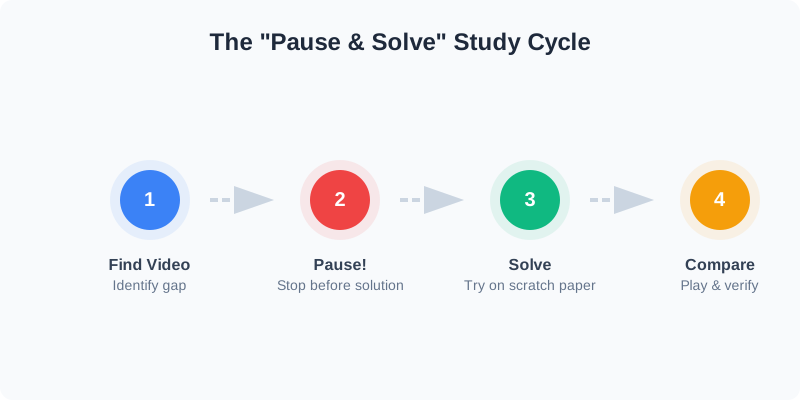
Here is the four-step active learning method you need to adopt.
Step 1: Diagnose Your Chemistry Gaps
Often, the issue isn't the current topic but a gap in foundational knowledge. Are you struggling with the chemical concept, or are you struggling with the algebra? If you can't balance the equation, it is a chemistry problem. If you can't isolate 'x', it is a math problem. Fix the math first.
Step 2: The "Pause and Solve" Method
When you find a relevant ChemTalk video, do not watch it straight through. Watch the setup, then pause the video before they solve it. Try it yourself on scratch paper. Yes, this is frustrating. But Educational Data (2023) shows that tutors see a 40% increase in student retention when students attempt to break down problems themselves before seeing the solution. Trial and error builds neural pathways.
Step 3: Break Down the Problem
If a problem seems impossible, break it into smaller, manageable parts. Don't look at a massive stoichiometry question and panic. First, write down what you are given. Second, write down what you need to find. Third, identify the conversion factors. This structural approach prevents you from freezing.
Step 4: Explain It Out Loud
Finally, teach the concept to an empty room or a study group. A 2024 study by M. O'Malley at UCSB demonstrated that collaborative study groups significantly boost grades, especially in organic chemistry. If you cannot explain why a reaction happens out loud, you don't truly understand it yet.
How to Succeed: Practical Application for Exams
Now that you understand the "Pause and Solve" method with ChemTalk, here is how to actually apply it to survive a 100-question midterm. You cannot just use these tools passively.
The Feynman Technique for Reactions
Named after physicist Richard Feynman, this technique requires you to explain a concept in the simplest terms possible. When you finish a ChemTalk article on SN1 vs SN2 reactions, close your laptop. Grab a blank sheet of paper and write out the mechanism as if you were explaining it to a middle schooler. If you have to use complex jargon to hide your confusion, you don't know the material.
Spaced Repetition for Nomenclature
Organic chemistry requires serious vocabulary memorization. Don't just stare at a list of functional groups. Use a spaced repetition system (SRS) like Anki. Create flashcards where the front is a ChemTalk structural image and the back is the IUPAC name. Anki forces you to review the hardest cards more frequently, which is vastly superior to traditional cramming.
Time-Saving Hacks for Lab Reports
Lab reports are massive time sinks. Instead of starting from scratch every week, build a template. Use the American Chemical Society (ACS) style guide format. When writing your discussion section, cross-reference your lab results with ChemTalk's theoretical values. This proves to your TA that you understand the gap between experimental error and theoretical perfection.
ChemTalk vs Khan Academy: Which is Better?
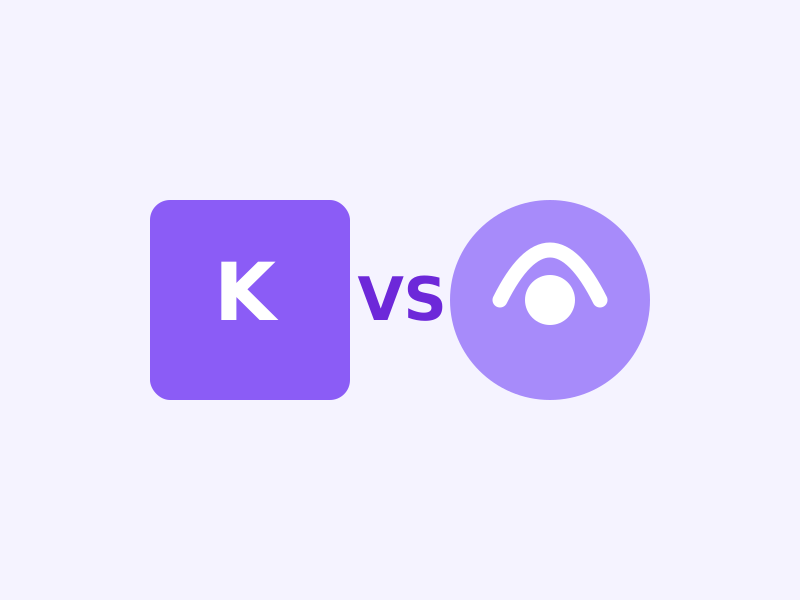
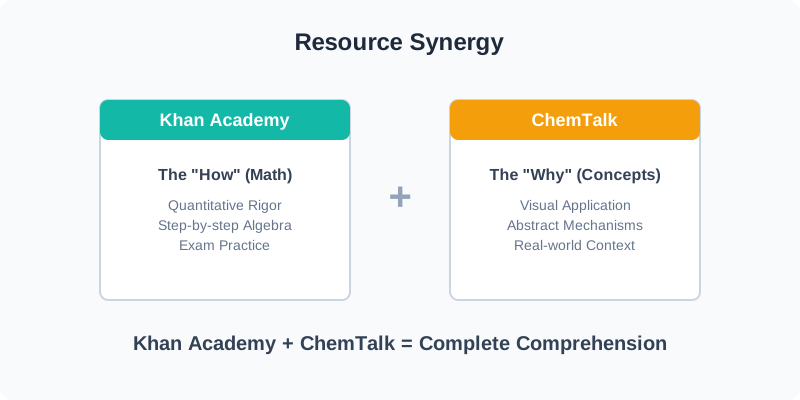
If there's one debate I hear constantly during office hours, it's whether to rely on Khan Academy or ChemTalk. Here is what most summaries miss: this isn't an either-or scenario. They serve completely different cognitive functions in your learning process.
The Khan Academy Approach: Structured Mathematical Rigor
Khan Academy functions like a highly organized digital classroom. It was built on sequential mastery and mathematical rigor. If you are struggling with the algebra of thermodynamics or calculating equilibrium constants, Khan Academy is unparalleled. It walks you through the quantitative side of chemistry step-by-step.
However, the limitation is that it heavily relies on digital whiteboard videos. A 2024 educational review published in MDPI (an open-access academic publisher) found that while traditional video lectures are excellent for demonstrations, they often promote a passive form of consumption unless paired with interactive tasks.
The ChemTalk Approach: Conceptual Application and Engagement
ChemTalk, on the other hand, operates as a non-profit outreach platform focused on making chemistry tangible. Rather than rigid courses, it offers highly visual, application-focused tutorials and articles. If you are struggling to visualize what a resonance structure actually is, ChemTalk's visual breakdowns are vastly superior to a static whiteboard.
The Journal of Chemical Education (2023) published a study demonstrating that students who engage with interactive, highly visual simulations and tutorials score 20% higher on conceptual exams. ChemTalk leans heavily into this visual, accessible methodology, ensuring you understand the "why" behind the "how."
The Head-to-Head Comparison
| Aspect | Khan Academy | ChemTalk |
|---|---|---|
| Key Focus | Sequential academic mastery and mathematical application. | Conceptual clarity, real-world context, and visual engagement. |
| Best For | Learning step-by-step math setups for exams. | Visualizing abstract mechanisms and understanding theories. |
| Limitations | Can feel dry; heavily relies on passive video watching. | Not structured as a strict A-to-Z course syllabus. |
| Example Application | Calculating the molarity of a complex titration. | Understanding the electron flow in an SN2 reaction. |
So, is ChemTalk better than Khan Academy? No—it's just different. In my experience teaching this for 12 years, the A-grade students use Khan Academy for the algebra and ChemTalk for the chemistry. Use Khan to learn how to crunch the numbers, but use ChemTalk to understand what those numbers actually represent in the physical world.
Common Mistakes Students Make Using Online Resources
Here's what I see students get wrong every time they rely heavily on digital study aids. They treat educational content like entertainment, and it destroys their exam performance.
Mistake 1: Treating Tutorials Like Netflix
The most fatal error you can make is watching a chemistry video while lying in bed. This creates the "Illusion of Competence." You watch a tutor elegantly solve a stoichiometry problem, you follow their logic, and your brain tricks you into thinking you can do it yourself.
As Dr. Eric Scerri, a renowned Chemistry Lecturer at UCLA, bluntly states: "Chemistry is not just a subject; it's a way of understanding the world around us. But you have to put in the reps." You cannot outsource the cognitive struggle. If you aren't holding a pencil, you aren't studying.
Mistake 2: Ditching the Textbook
Students frequently ask, "Can ChemTalk replace my textbook?" Absolutely not. There is a genuine debate about textbook pricing in higher education, but from a pedagogical standpoint, your textbook is the definitive source of truth for your specific course.
Your professor writes exams based on the textbook's specific terminology and problem sets. ChemTalk and Khan Academy are supplementary. They are the translators. When the textbook reads like a foreign language, use online resources to translate it into plain English. But you must eventually return to the textbook to practice the exact phrasing your professor expects.
Mistake 3: Skipping the Foundational Math
I'll be honest—I struggled with this concept too when I was a freshman. Students often blame "chemistry" when their real weakness is basic algebra. The U.S. Department of Education (ed.gov) notes significant national gaps in post-secondary math readiness.
If you don't understand fractions, ratios, and basic algebraic isolation, you will fail stoichiometry. No amount of ChemTalk videos can save you if you can't isolate 'x'.
Frequently Asked Questions (FAQ)
Students ask these questions every semester. Here are the direct answers.
What is the best way to study organic chemistry?
Focus on understanding the "why" behind electron flow, not rote memorization. Use ChemTalk's visual tutorials to see the mechanisms in action. Collaborative study groups significantly boost grades in organic chemistry, because arguing over a mechanism forces you to justify your logic.
How many hours should you study for chemistry?
Quality beats quantity. One hour of active problem-solving (where your pencil is moving) is better than three hours of passive reading or watching videos. Aim for 2-3 hours of active practice per credit hour, per week.
Essential Chemistry Study Resources
Do not rely on a single platform. Build a toolkit. Here is what I recommend to every freshman:
Free Open-Source Textbooks
If your assigned textbook is too dense, use OpenStax Chemistry. It is a peer-reviewed, .edu-backed open-source textbook that explains concepts clearly without the $200 price tag.
Professional Organizations
The American Chemical Society (ACS) provides incredible student resources, including career guidance and standardized exam study guides. Their materials align perfectly with what most professors use for final exams.
Need Immediate Help?
If you have fallen too far behind and ChemTalk isn't enough to save your grade, we can step in. Our professional tutors at PaySomeoneToTakeOnlineClass offer emergency 1-on-1 tutoring and full-course management to ensure you pass.
Conclusion: Your Next Steps
You started this article wondering how to avoid becoming part of that 23.2% dropout statistic. Now you have a proven, active-learning framework to tackle college chemistry head-on.
- Stop treating video tutorials like Netflix—use the "Pause and Solve" method.
- Use Khan Academy for mathematical rigor and ChemTalk for conceptual visualization.
- Never abandon your primary textbook, as it dictates your exam terminology.
- Implement the Feynman Technique to ensure you actually understand the mechanisms.
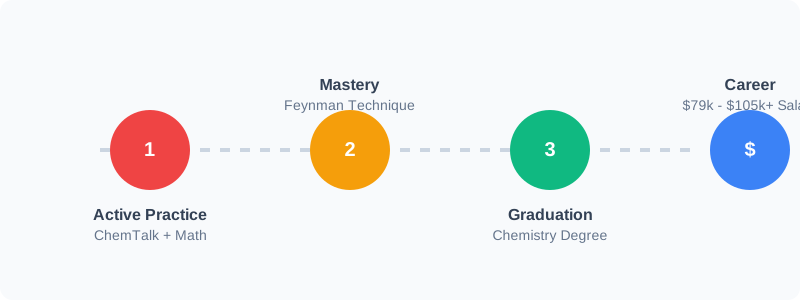
You've got this. The effort is worth it. According to the Bureau of Labor Statistics (BLS) projections for 2026, chemistry graduates enter a highly lucrative market, with Chemical Engineers earning a median salary of $105,517 and Chemists earning around $79,428. The struggle today pays off tomorrow.
Here's your next step: Tonight, pick one topic you are struggling with. Find the ChemTalk article, grab a blank piece of paper, and apply the Feynman Technique. If you still need help, reach out to our experts today.