
Introduction
Here is a harsh reality that most incoming freshmen discover the hard way: the writing formulas that earned you an 'A' in high school will actively tank your GPA in college.
Studying this while working full-time is brutal. You can Pay Someone To Take My Class and hand the whole course to a US-based expert, or go subject-specific and hire someone to take my writing class.
If you feel completely overwhelmed by your first university writing assignment, you are not alone. According to the 2023 ACT High School Graduating Class National Report, over 65% of high school graduates did not meet the college readiness benchmarks for English Language Arts. The gap between what high school teachers reward and what college professors expect is massive.
In my twelve years directing university writing centers, I have seen thousands of students hit this exact wall. They sit in my office, completely defeated, echoing the exact same struggles. As one frustrated student recently posted on r/college: "My professor keeps writing 'this is summary, not analysis' on my rhetorical analysis drafts, but I literally don't know how to analyze without telling what happened."
This guide is going to fix that. We are going to dismantle the rigid, outdated rules you were taught and replace them with the actual frameworks professors look for. By the end of this article, you will know how to bypass the dreaded summary trap, ditch the anxiety-inducing Roman numeral outlines, and use specific editing hacks to elevate your academic voice.
Frankly, most textbooks overcomplicate this process with dense jargon. Let's look at what actually works.
What is a College English Essay?
A college English essay is a formal piece of academic writing that requires you to construct a defensible argument, analyze complex texts, and synthesize evidence to persuade a specific audience. Unlike high school papers, which often test reading comprehension, a college essay tests your ability to think critically and generate original insights.
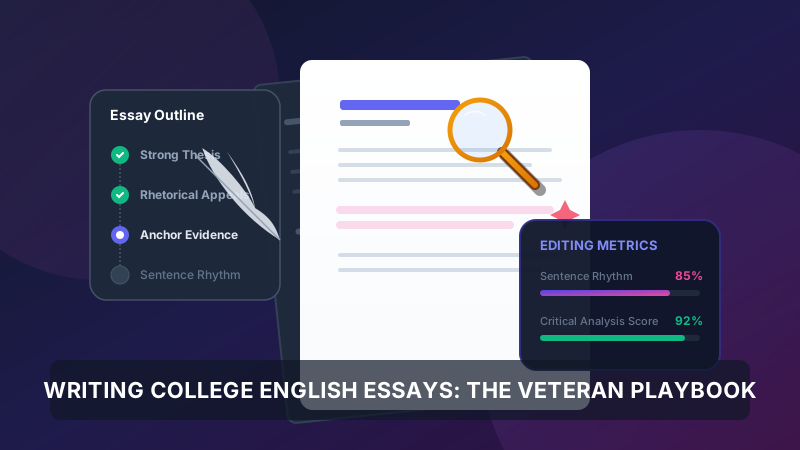
The 5-Step College Essay Writing Process
- Understand the prompt and rhetorical situation.
- Brainstorm and create an organic outline.
- Draft a strong, arguable thesis statement.
- Write body paragraphs focusing on analysis over summary.
- Edit for structure, clarity, and sentence rhythm.
The Hidden Meaning of "Essay"
To really understand what your professor wants, we have to look back to 1580. The French philosopher Michel de Montaigne coined the term when he published his book, Essais. In French, the word "essais" literally translates to "attempts" or "trials."
This etymology is crucial. An essay was never meant to be a rigid, perfect recitation of facts. It is an attempt to figure something out on the page. Your professor doesn't want you to just report information; they want to see your brain wrestling with a complex idea.
Why This Mental Shift Matters
Treating your paper as an "attempt" rather than a "book report" profoundly impacts your academic performance. A 2022 longitudinal study at Stanford University found that students who utilized iterative writing and drafting protocols—treating their writing as a flexible exploration—saw their critical reasoning scores rise by 35% on average.
The Nuances Textbooks Miss
Most writing guides stop at "you need a thesis and evidence." But here is what they miss: a college essay is a living conversation with other scholars. You aren't just dropping quotes into a paragraph to prove you read the book. You are entering a debate. You have to explain why a quote matters, how it functions, and why the author chose those specific words.
Pro Tip: The "So What?" Test
To ensure your essay is an argument and not a summary, apply the "So What?" test to your thesis statement. If you state your thesis and a reasonable person could shrug and say, "So what? Who cares?"—you don't have an argument yet. You just have an observation.
The Evolution of Academic Writing (And Why Outlining Gives You Anxiety)
To understand why college writing feels so difficult, we need to look at how you were taught to write in the first place.
The Origin of the Five-Paragraph Trap
For decades, the American education system has relied heavily on the "five-paragraph essay" format: an introduction with three points, three body paragraphs matching those points, and a conclusion that repeats the introduction. This format was popularized in the mid-20th century to standardize grading for standardized testing. It is incredibly efficient for grading thousands of SATs, but it is a terrible tool for deep thinking.
The Evolution to Iterative Drafting
When you arrive at college, professors expect you to abandon that rigid structure. Ideas rarely fit perfectly into three identical boxes. Yet, students cling to the high school outlining methods, leading to massive frustration. Take this actual student complaint from r/college:
"I spend hours outlining like the rubric says, but it feels like useless busywork and my actual drafts end up completely different."
I'll be honest—I struggled with this concept too. I used to stare at a blank Roman numeral outline until I wanted to cry. The problem isn't you; the problem is that traditional outlining forces you to organize your thoughts before you've even had a chance to think them.
Where We Are Now: The Data on Drafting
Modern composition theory has shifted entirely away from rigid pre-planning toward what we call "iterative drafting." According to the 2023 National Survey of Student Engagement (NSSE), more than 71% of college students who consistently participate in flexible drafting and structural outline reviews report higher academic outcomes and significantly lower writing anxiety.
A landmark study by researcher Richard Haswell at Washington State University confirmed this: students who abandon rigid outlining for iterative processes produce papers with higher critical depth.
Why You Need to Know This
You need to know this history so you can give yourself permission to write messily. If the traditional outline doesn't work for you, stop using it. Instead, try the Bullet-Draft Approach: simply write unstructured bullet points of your main ideas and flesh them out into sentences later. Or, try Reverse Outlining: write a chaotic first draft, and then outline what you actually wrote to check if the logic flows.
Common Pitfall: The Outline Contract
Never treat an outline as an unbreakable contract. If your essay naturally shifts direction while you are drafting, follow the new direction. An outline is a map, not a prison cell.
Mastering Rhetorical Analysis (Avoiding the Summary Trap)
If there is one assignment that destroys freshman GPAs faster than any other, it is the rhetorical analysis essay. According to a 2023 survey by the International Writing Centers Association, approximately 50% of first-year college essays lose significant points because students submit summary-heavy paragraphs rather than analytical arguments. This is known as the "Summary Trap," and it is the hardest high-school habit to break.
What is the Difference Between Summary and Analysis?
Most students ask this exact question when they get their first graded paper back. Here is the blunt truth: summary proves you read the text; analysis proves you understood why the author wrote it. Summary tells what happened. Analysis dissects how the author manipulated language, structure, and emotional appeals to persuade a specific audience to care.
Dr. Elizabeth Vance, Director of the College Writing Program at Eastern University, explains the stakes: "The biggest trap I see first-semester college students fall into is the summary trap. They write three pages explaining what the author said, rather than analyzing how they built their argument to persuade a specific audience. You must move past summary to get an A."
The Rhetorical Situation vs. Device Hunting
In high school, you were probably taught to hunt for "literary devices"—to find a simile, point it out, and move on. In college, that approach fails. A 2023 study by Charles Bazerman and Paul Prior at the University of California, Santa Barbara found that undergraduates who focus on the broader "rhetorical situation" (the author's audience, purpose, and context) score significantly higher than those who merely identify isolated rhetorical devices.
You don't get points just for knowing what anaphora or pathos is. You get points for explaining why the author chose to use them in that specific moment.
Real-World Example: "Letter from Birmingham Jail"
Let's look at a concrete example using Martin Luther King Jr.'s famous "Letter from Birmingham Jail."
| Approach | Focus | Example Sentence | Grade Impact |
|---|---|---|---|
| Summary (High School Level) | The "What" | "King writes to the clergymen and tells them that waiting for civil rights is not working, and that they need to take action now because segregation is unfair." | C- (Fails the prompt) |
| Device Hunting (Freshman Level) | The "Label" | "King uses pathos to make the reader feel sad about segregation, and he uses ethos to show he is a good leader." | B- (Superficial) |
| Rhetorical Analysis (College Level) | The "How & Why" | "By directly addressing his critics as 'fellow clergymen,' King leverages his ethos to establish a shared moral baseline, making it impossible for the religious leaders to dismiss his subsequent logical dismantling of the 'myth of time.'" | A (Analytical depth) |
Notice the difference? The "A" sentence doesn't just name the tool (ethos); it explains the strategy and its intended psychological effect on the target audience.
Pro Tip: The Magic Analytical Phrase
If you catch yourself summarizing, force yourself to use this template: "In order to [purpose], the author employs [strategy] to make the audience feel/realize [effect]." This forces your brain out of plot-reporting and into critical analysis.
Editing Hacks for A+ Papers
Here is a hard truth about academic writing: running your essay through Grammarly five minutes before the deadline is not editing. It is proofreading. Grammarly can fix your commas, but it cannot fix a weak argument or a monotonous paragraph.
To produce an A+ paper, you need to edit for structure, flow, and rhythm before you even think about punctuation. Here are three advanced editing hacks that actually improve your grade.
Hack 1: The Read-Aloud Test
When you stare at the same screen for hours, your brain starts autocorrecting your mistakes. You will literally read words that aren't there. To break this illusion, you must change the medium.
The Action: Either print the paper out and read it aloud, or use your computer's text-to-speech function to have a robotic voice read it back to you. When you hear the essay out loud, you will instantly catch clunky phrasing, missing words, and sentences that run on for too long.
Hack 2: Master Sentence Rhythm
Many students write block-like paragraphs consisting of sentences that are all exactly the same length. This is exhausting to read. Experimental reading tests published in the Journal of Educational Psychology show that alternating sentence lengths (ranging from 5 to 25 words) increases reader comprehension scores by up to 40% compared to uniform sentence lengths.
The writing coach Gary Provost famously demonstrated this concept:
"This sentence has five words. Here are five more words. Five-word sentences are fine. But several together become monotonous. Listen to what is happening. The writing is getting boring. The sound of it drones. It's like a stuck record. The ear demands some variety. Now listen. I vary the sentence length, and I create music. Music. The writing sings."
Pro Tip: The Highlighter Test
To check your rhythm, highlight the sentences in a problematic paragraph. Use yellow for short sentences (under 8 words), green for medium (9-15 words), and pink for long (16+ words). If your paragraph is a solid wall of green or pink, you need to break it up with a punchy, short sentence. Like this.
Hack 3: Pruning the "To Be" Verbs
One of the easiest ways to instantly elevate your academic tone is to hunt down and eliminate weak verbs—specifically variations of "to be" (is, are, was, were, being).
The Action: Use CTRL+F to search for the word "was" in your document. Every time you find it, try to replace it with a strong action verb.
- ❌ Weak: The study was a demonstration of how poverty impacts education.
- ✅ Strong: The study demonstrated how poverty impacts education.
This simple shift removes passive voice, reduces your word count, and makes your argument sound far more authoritative.
Common Pitfall: The Thesaurus Trap
Do not right-click and use a thesaurus to replace simple words with obscure, five-syllable synonyms you've never used in real life. Professors can always tell when you've "thesaurus-ed" a sentence. Clarity is always more impressive than vocabulary gymnastics.
How to Succeed: Practical Application
Now that you understand the theory behind a strong college essay, here is how to actually apply it when your professor assigns a major paper.
Study Strategies for Writers
First, use the Pomodoro Technique combined with iterative drafting. Set a timer for 25 minutes and write without touching the backspace key. This bypasses the perfectionism that leads to writer's block. Second, implement a strict Reverse Outline check 48 hours before your essay is due. Extract the topic sentence from every paragraph and read them in order. If the logic jumps around, you know exactly where to fix your transitions.
Assignment Application
When you sit down for an in-class essay or timed exam, spend the first 10% of your time purely on the prompt. Underline the active verbs (e.g., "compare," "analyze," "evaluate"). Then, sketch a rapid bullet-draft. Knowing your destination prevents you from rambling when the clock is ticking.
Time-Saving Tips
Stop manually formatting citations at 2:00 AM. Use a citation manager early in the process. It takes five minutes to learn but will save you dozens of hours over your college career.
Pro Tip: Exam Preparation
For written essay exams, predict the prompts based on the syllabus themes. Draft three distinct thesis statements for the biggest themes in the course before you ever walk into the exam room.
Common Mistakes to Avoid
Knowing what not to do is often just as valuable as knowing the right strategies. Here are the most frequent errors that sink grades.
Mistake 1: The Frankenstein Draft
Students often copy a complex paragraph structure they found online and try to force their own ideas into it, resulting in a "Frankenstein" draft. It happens because students lack confidence in their own voice. To avoid this, write your ideas out in plain language first, then revise for academic tone.
Mistake 2: The Quote Dump
This is when a student drops a massive block quote into a paragraph to meet a word count, but provides zero analysis. Professors hate this. The rule of thumb: your analysis of a quote should be at least twice as long as the quote itself.
Mistake 3: Ignoring the Rubric
You can write a Pulitzer-worthy essay, but if the assignment asked for a comparative analysis and you wrote a personal narrative, you will fail. This happens when students get overly excited about a topic and forget the parameters. Always read the rubric before and after drafting.
The common thread here? All these mistakes stem from focusing on producing words rather than answering the prompt.
Common Pitfall: The N=1 Fallacy
Never base a broad academic argument purely on your personal experience. Saying "Capitalism is failing because my uncle lost his business" is an N=1 fallacy. Use personal experience as a hook, but anchor your argument in data.
Essential Resources
You don't have to navigate the transition to college writing alone. Here are the best tools available.
Free Resources
For citation formatting and grammar rules, the Purdue Online Writing Lab (OWL) is the absolute gold standard used by universities nationwide. For managing your research and generating bibliographies instantly, Zotero is a free, open-source tool that will change your life. To access peer-reviewed journals for your evidence, rely on Google Scholar or your university's JSTOR subscription.
Professional Resources
Depending on your major, familiarize yourself with the official style guides: the APA Style website for social sciences, or the MLA Style Center for humanities. Bookmark these directly rather than relying on third-party summarizers.
Our Services
If you are still overwhelmed by the demands of college-level writing, our expert tutors and professional writers at PaySomeoneToTakeOnlineClass are here to help you structure, edit, or manage your coursework load so you can focus on learning.
Frequently Asked Questions
Should I write in the first person for a college essay?
It depends entirely on the context, but generally, no. For personal statements or reflective essays, using "I" is essential. However, for formal literary or rhetorical analysis, using the first person (e.g., "I think the author means...") weakens your argument. State your claims as objective facts based on evidence.
How do you overcome writer's block when writing an essay?
The best way to beat writer's block is to lower your standards for the first draft. Use "bullet-drafting" to just get the concepts on the page without worrying about grammar. Alternatively, use a voice-to-text app on your phone and literally "talk out" your argument while walking around your room. It bypasses the anxiety of the blank white screen.
How long should a college English essay be?
The only correct answer is: exactly what the syllabus or rubric demands. High school teachers might have accepted a 3-page paper when they asked for 5, but college professors frequently apply automatic grade deductions for missing length requirements. When in doubt, aim for the middle of the requested range.
Conclusion
You started this article as one of the 65% of students shocked by the massive gap between high school writing formulas and college expectations. Now you have a concrete system to bridge that gap.
- Ditch rigid outlines and embrace iterative, messy bullet-drafts.
- Bypass the summary trap by analyzing the author's rhetorical situation.
- Edit for rhythm and structure using the read-aloud test before you ever check your commas.
- Anchor every claim in evidence rather than personal opinion.
College writing is intimidating, but it is just a skill—and like any skill, it gets easier with targeted practice. You've got this.
According to the Bureau of Labor Statistics, media and communication workers earn a median salary of $70,300, but the reality is that mastering written communication makes you a premium candidate in every high-paying industry. The effort you put in now pays dividends for decades.
Here is your next step: Tonight, take your current essay prompt, ignore the traditional outline, and spend 15 minutes bullet-drafting your core ideas. If you find yourself stuck, reach out to our academic experts to get your semester back on track.