

Introduction
First-year attrition rates in ABA-accredited law schools stood at 3.8% in 2023, driven largely by academic performance pressure and the shock of adapting to legal writing. If you feel like you are drowning in your business law class, you are absolutely not alone. The transition from writing standard college essays to drafting structured legal analysis is brutal.
I constantly see students panic when they get their first graded case study back. The most common piece of feedback I leave on those papers looks like this: "Conclusory analysis. You stated the rule, then jumped straight to a conclusion." A student on a popular college forum perfectly captured this exact frustration recently. They wrote, "I'm struggling with the 'because' part of my application." They know the answer, but they cannot prove it on paper under the strict time constraints of an exam.
Frankly, most textbooks get this wrong. They give you vague advice about "thinking like a lawyer" instead of giving you a mechanical structure. This guide will provide you with a rigid, step-by-step formula to construct the perfect business law case study. You will learn exactly how to build the application section so you never lose points for conclusory writing again.
Here is what 12 years of grading has taught me. Grading rubrics do not reward creativity. They reward structure. Let me show you how to beat the rubric.
Why IRAC Exists (And Why Your Professor Demands It)
The IRAC method is a structural framework used in legal writing to organize analysis. It stands for Issue, Rule, Application, and Conclusion. This method ensures that all relevant facts and legal rules are methodically connected to reach a logical outcome.
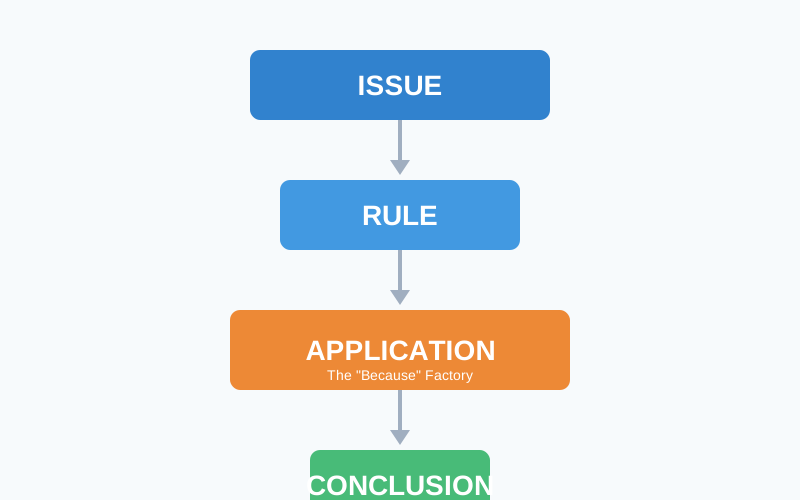
The term itself might sound intimidating. But it is just a checklist. Legal writing is about logic, not prose. You do not need to write like Hemingway to get an A in business law. You just need to follow the formula step by step.
Why do professors care so much about this specific format? Because the legal profession demands it. In survey data of legal professionals, a 2026 Wolters Kluwer Future Ready Lawyer Report found that 87% of attorneys cited clarity and mechanical organization as more persuasive than complex, unstructured prose. When you enter the corporate world, nobody has time to hunt for your main point. They want the issue identified, the rule stated, and the facts applied immediately.
I will be honest. The strictness of this format frustrates a lot of creative thinkers. Most students want to tell a story. They want to summarize the facts of the case in a long narrative, just like they did in high school English. But a case study is not a book report. Graders actually do not care if your final conclusion is correct in a controversial case. They only care about how you logically connected the law to the facts to get there. If you skip the connective tissue, you fail the assignment.
Think of it like an algebra test. Your math teacher always told you to show your work. Getting the right number at the bottom of the page means nothing if you cannot prove the steps. The IRAC method is simply the legal version of showing your work.
By forcing you into this structure, your professor is actually doing you a favor. It removes the guesswork from writing. You never have to stare at a blank page wondering how to start. You just write the heading for "Issue" and begin.
The Origins of the IRAC Method (And Why It Still Dominates)
To understand why your professor is so obsessed with this acronym, you have to look at where it came from. The exact genesis of IRAC is debated among legal scholars. Historical research published by Marquette University Law School traces its widespread adoption to the 1960s. During this time, bar review educators like Michael Josephson popularized strict organizational frameworks to help students pass grueling state exams. They needed a foolproof way to ensure students hit every point on the grader's checklist.
Another popular origin story suggests a more tactical beginning. Some historians believe the method was adapted from a problem-solving framework used by the United States Army during World War II. The military needed to train a massive influx of new recruits quickly. They developed rigid, sequential logical models to help soldiers solve battlefield problems under extreme pressure. That same structured thinking eventually found its way into the legal academy.
Whatever its true origin, IRAC exploded in popularity over the last fifty years. It transitioned from a simple bar prep tool into the undisputed gold standard of American legal education. And it did not stop at law schools. Today, undergraduate business law courses rely heavily on the exact same grading criteria. Professors know that if a student can master this framework early, they are far more likely to succeed in advanced courses.
The stakes for mastering this structure are incredibly high. According to 2023 survey data from the Association of Legal Writing Directors (ALWD), legal research and writing grades are factored directly into the cumulative GPA at 75% of law programs. Even if you are just taking a single undergraduate business law prerequisite, the grading curve is famously unforgiving. Up to 15% of grades are lost on preventable structural errors alone, according to a 2024 review in Academic Support Pedagogy.
You need to know this history because it explains your professor's mindset. They were trained this way. Their grading rubrics are built this way. If you try to write a traditional college English essay instead of a structured legal memo, you are speaking a language your grader does not want to hear.
Step 1: The Issue (Asking the Right Question)
If you ask the wrong question, the rest of your analysis does not matter. The Issue statement acts as the compass for your entire case study. If your compass is broken, your application will wander aimlessly.
So, what exactly is an issue statement? It is a highly specific legal question that the court (or you, as the analyst) must answer to resolve the dispute. Most students get this wrong by writing broad, generic statements that look like chapter titles in a textbook rather than specific legal inquiries.
Let's use a massive, real-world business failure to illustrate this. Take the 2022 Southwest Airlines meltdown. When their internal scheduling software collapsed during the Christmas holiday, the airline canceled approximately 17,000 flights and stranded over two million passengers. The U.S. Department of Transportation (DOT) eventually issued a record-breaking $140 million civil penalty against the airline in December 2023 for consumer protection violations.
If your professor assigned this scenario to determine if Southwest breached its contract of carriage, here is how you might draft the issue:
- Terrible Issue Statement: "The issue is contract law." (This is a topic, not a question.)
- Bad Issue Statement: "Did Southwest breach their contract?" (Too vague. Which contract? When?)
- Perfect Issue Statement: "Did Southwest Airlines breach its contract of carriage with ticketed passengers when it failed to provide timely rebooking or alternative transportation during the December 2022 system failure?"
Step 2: The Rule (Stating the Objective Law)
This is where you lay down the law—literally. But this is also where I see students start bleeding points rapidly. The Rule section has one job: to state the objective legal principles, statutes, or precedent that apply to the issue you just identified. It is effectively the dictionary definition of the law.
There is a massive catch, though. The Rule section must contain absolutely zero facts from your specific case.
According to a 2023 study published by Davies and Sterling at the University of Denver, "The primary cognitive barrier for students in legal writing is distinguishing the rule statement from the fact application, leading to repetitive or conclusory prose." This is exactly why you might find yourself wondering: How do I separate the Rule section from the Analysis section without repeating myself?
The answer is strict conceptual separation. Think of the Rule as a pure, sterile laboratory environment. If we go back to our Southwest Airlines example, the Rule section should only list the elements required to prove a standard breach of contract. It should look something like this: "To establish a breach of contract, a plaintiff must prove: (1) the existence of a valid contract, (2) the plaintiff's performance under the contract, (3) the defendant's material breach of the contract's terms, and (4) resulting damages to the plaintiff."
Notice what is missing? I did not write the word "Southwest." I did not mention canceled flights. I only stated the law.
IRAC case analysis takes hours. If you are short on time, you can pay someone to take my online class for me with complete privacy, or go subject-specific and take my business law class for me.
Step 3: The Application (The "Because" Factory)
The Application (sometimes called Analysis) section is the entire reason your professor assigned the case study. The Issue and the Rule are just the setup; the Application is where you earn your grade. If you mess this up, you fail the assignment.
The data backs this up. According to a 2023 report in the Journal of Legal Education, instructors note that 60% of students receiving a grade below B- on case studies fail to meet the minimum application density on their rubrics. They simply do not write enough analysis.
The number one killer in the Application section is something called conclusory writing. Conclusory writing happens when you state the rule, jump straight to the final conclusion, and completely skip the logical steps connecting the two. You assume the reader knows why the defendant is guilty, so you do not bother explaining it.
Prof. Arthur Pendelton perfectly summarizes this frustration: "The biggest feedback I give students is that their analysis is conclusory. They state the rule, then state the conclusion, and completely hide the logical steps in between. You must show the reader how you got there."
To fix this, you need to use the Law because Fact formula. You must explicitly tie a specific piece of the rule to a specific fact from the case. The word "because" is your best friend here.
Let's look at the Southwest Airlines example again:
- Conclusory Application (Failing Grade): "Southwest clearly breached the contract of carriage because they stranded passengers and ruined Christmas. Therefore, they are liable for damages."
- Analytical Application (A-Grade): "The defendant's material breach of the contract's terms is satisfied because the Southwest Contract of Carriage explicitly guarantees passengers a seat on the next available flight in the event of an airline-initiated cancellation. Southwest failed to fulfill this obligation because internal DOT audits confirm the airline canceled 17,000 flights and their scheduling system prevented them from offering alternative transportation within the required 48-hour window, constituting a material breach of that specific clause."
See the difference? The good example takes a piece of the rule ("material breach") and glues it to a specific fact ("canceled 17,000 flights").
Step 4: The Conclusion (Keep It Brief)
By the time you reach the Conclusion, the heavy lifting is completely finished. The Conclusion is not the place to be profound. It is simply the place where you answer the specific question you asked back in Step 1.
Your conclusion should rarely be longer than one to three sentences. For our running example, it would simply read: "Yes, Southwest Airlines breached its contract of carriage with ticketed passengers because it failed to provide the required alternative transportation after initiating massive systemic cancellations."
A question I hear constantly in office hours is: What should I do if a legal case study doesn't have a clear winner or definitive outcome?
Frankly, most real-world lawsuits don't have obvious answers. That is why they go to trial. Graders do not actually care if you pick the "correct" winner in a highly ambiguous case. They care that your final conclusion logically follows the analysis you just wrote. In fact, a review of standard law school grading rubrics shows that the Conclusion section typically accounts for only 10% to 15% of your total grade, whereas the Application section carries 25% to 40% of the weight.
If the case is a genuine toss-up, state that the court will likely find in favor of the plaintiff, but immediately acknowledge the strongest counter-argument the defendant has. Being able to see the gray area proves you understand the law better than a student who pretends the case is black and white.
Common IRAC Mistakes That Bleed Points
Even if your legal logic is flawless, you can still lose a full letter grade by ignoring formatting conventions. A 2024 review published in Academic Support Pedagogy found that up to 15% of grades on case studies are lost on preventable structural and formatting errors rather than a misunderstanding of the law. Professors read hundreds of these essays a week. If you make your analysis hard to find, they will simply stop looking for it and mark you down.
Students frequently ask: Is it better to use subheadings for each issue or write one continuous essay?
I will tell you what every grader is thinking but won't put on the syllabus: use the exact acronym as bolded subheadings. Write one continuous essay in an English literature class. In a business law class, we want clear, separated buckets of information. It guarantees you will not accidentally mix your Rule with your Application.
| Format Approach | The "Block Essay" Method | The "Explicit Subheading" Method |
|---|---|---|
| Key Focus | Writing a traditional narrative with smooth transitions. | Breaking analysis into clearly labeled sections (Issue, Rule, etc.). |
| Best For | English, History, and Sociology papers. | Business Law, Legal Memos, and Case Studies. |
| Limitations | Extremely prone to conclusory writing and skipping rule elements. Grader has to hunt for your points. | Feels "choppy" and unnatural to write at first. |
| Result on Rubric | Often docked for "lack of clarity" or "poor organization." | Ensures grader sees every required element instantly. |
Ultimately, writing a business law case study is an exercise in discipline. You have to shut off the creative writing side of your brain and engage the analytical, formulaic side. If you master the IRAC structure, you will not only survive your business law courses, but you will also learn how to build bulletproof, persuasive arguments for the rest of your professional career.
How to Succeed: Practical Application of IRAC
Now that you understand the mechanics of IRAC, here is how to actually apply it without losing your mind during finals week.
Study Strategies for Case Law
First, stop trying to memorize full cases. Use the Case Briefing Method. Before class, distill every assigned case into a mini-IRAC on a single index card. When it is time to study, you will have a stack of flashcards with perfectly formatted issue statements and rules. Second, try the Reverse IRAC Technique. Take an A-grade sample essay (or a court opinion) and highlight the Issue in yellow, the Rule in green, the Application in blue, and the Conclusion in pink. If you see a massive block of green mixed with blue, you know the writer messed up their structure.
Applying IRAC to Exams
When you sit down for a timed exam, the clock is your enemy. Do not write your essay chronologically. Write the Issue, then immediately write the Rule. Leave a huge blank space. Then write your Conclusion at the bottom. Why? Because the Application takes the longest. If you run out of time while writing the Application, you will still get points for identifying the issue, stating the law, and having a conclusion.
Advanced Mistakes That Cost You the 'A'
We already covered formatting pitfalls, but what about the substantive legal errors? In my experience, even students who nail the IRAC format can still fail if they fall into these cognitive traps. A quick glance at any law student forum reveals the same struggles over and over.
Mistake 1: "Rule Dumping"
Students often panic and engage in "rule dumping"—reciting every legal principle they memorized about a topic without context. For example, if the issue is a specific breach of a delivery contract, they will write two pages about the history of contract law. Why does this happen? Anxiety. How to avoid it? Only write the exact rule that applies to the specific facts of the case. Graders deduct points for irrelevant rules because it shows you don't actually know which law applies.
Mistake 2: Ignoring Counterarguments
Another major error is writing a one-sided analysis. Students often assume there is only one "right" answer and ignore the opposing side's strongest argument. This makes the analysis appear superficial. To avoid this, always include a sentence starting with, "However, the defendant will likely argue that..." Addressing the counterargument proves you understand the gray areas of the law.
Mistake 3: The N=1 Fallacy
Many students rely on their personal moral compass or one previous case they read to decide the outcome, ignoring the objective rule they just stated. They write, "This isn't fair because..." Fairness is not a legal rule. Apply the law objectively, even if the outcome feels harsh.
Essential Resources for Business Law Students
You do not have to master this alone. There are incredible tools available to help you streamline your legal writing.
Free Academic Resources
If you are struggling with the underlying legal concepts, ditch your dense textbook and use OpenStax or LibreTexts for simplified, plain-English summaries of business law. For finding case law and precedents, use databases like Google Scholar (select the "Case law" button) or the official portal at uscourts.gov. They provide free access to opinions that you can practice Reverse IRACing on.
Professional Resources
For formatting and citation help, bookmark the Legal Information Institute (LII) at Cornell Law School (law.cornell.edu). It is arguably the best free legal dictionary and encyclopedia on the internet. Additionally, reviewing the American Bar Association (ABA) guidelines on legal writing can give you a massive edge over your peers.
Need Expert Help?
If you are still overwhelmed by the strict grading rubrics and time constraints, we can help. Our team of business law experts can guide you through complex case studies or even take your online class to guarantee a passing grade. Sometimes, the smartest move is knowing when to call in a professional.
The Final Verdict: Practice Makes Perfect
You started this article staring at a 3.8% law school attrition rate and wondering how you were ever going to survive a business law case study. Now you have the exact blueprint that professors use to grade them.
- Issue: Ask a specific, fact-based legal question ending in a question mark.
- Rule: State the objective law with zero facts from the case.
- Application: Use the "Law because Fact" formula to prove every element.
- Conclusion: Briefly answer your original question and address counter-arguments.
I know this feels incredibly rigid right now. But remember that according to the Bureau of Labor Statistics, corporate counsel and business lawyers are projected to earn a median salary of over $151,160 by 2026, with top earners making well over $200,000. That salary is not for being creative; it is for being clear, objective, and analytical. This is your training ground.
You've got this. The structure is your safety net.
Here's your next step: Tonight, take an old case study assignment you already submitted, grab four different highlighters, and try the Reverse IRAC Technique. See where your colors bleed together.
If you find that your analysis is still a mess and finals are looming, reach out to our expert tutoring and course-management team today.