
Introduction
If you're staring at your math homework wondering why an equation looks like a completely different language, you aren't alone. A 2014 report published by the U.S. Department of Education (ed.gov) found that only about 35% of students met or exceeded standards in analytic geometry. The rest of the class? They hit a massive conceptual wall.
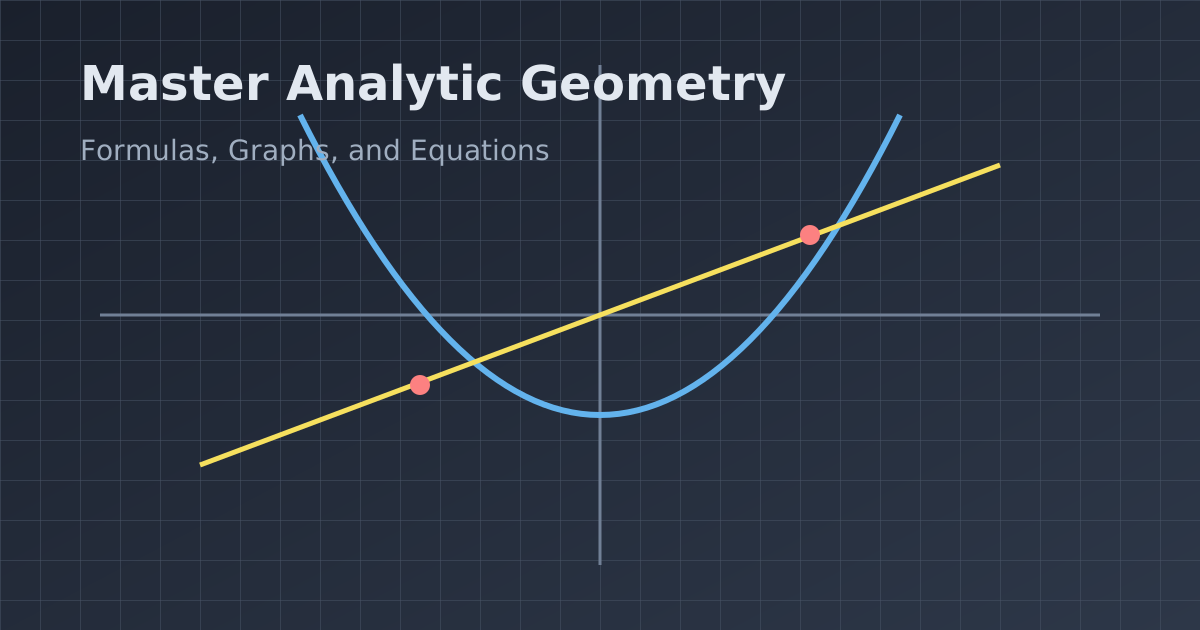
In my office hours, I see about 3 students per week confused by this exact issue. They sit down with pages of algebraic scribbles, completely lost, and tell me they feel like they are drowning in proofs. The formulas seem endless, and knowing which one to use when feels like a nightmare. But here is the reality: the real struggle isn't the algebra itself—it's translating those equations into a geometric visualization. When you can't see the shape in your mind, the numbers stop making sense.
Frankly, most textbooks get this wrong. They focus purely on the theory and expect you to memorize standard forms without providing a visual anchor. In this guide, I'm going to show you exactly how to bridge that gap. We won't just list equations; we will break down the specific calculation slips and procedural mistakes that graders actually dock points for.
After 12 years of teaching and grading thousands of exams, I know the 'Euclidean Trap' you're about to fall into. By the end of this guide, you'll have a mental framework that makes coordinate geometry intuitive, plus a survival cheat sheet you can use on your next assignment.
What is Analytic Geometry?
Analytic geometry is a branch of mathematics that uses algebraic equations to describe geometric shapes. By using the Cartesian coordinate system, it allows you to locate points, lines, circles, and curves using ordered pairs of numbers, making it possible to solve complex geometric problems through algebra.
Before this concept existed, geometry was purely synthetic. Synthetic geometry is what you learned in middle school: proving a triangle's angles add up to 180 degrees using axioms, compasses, and straightedges. Analytic geometry drops the physical tools and replaces them with variables and equations. You're no longer saying "Line A is parallel to Line B because of alternate interior angles." You're saying "Line A is parallel to Line B because their algebraic slopes both equal 2." It is a massive shift in thinking.
Why does this matter to you right now? Because analytic geometry is the engine behind modern engineering, computer graphics, and physics. Take the 2024 development of advanced autonomous driving software. These self-driving cars don't "see" roads like human eyes do; they process millions of spatial coordinate points per second using the exact same fundamental distance formulas you are studying today. If a programmer codes a minus sign incorrectly, the car mathematically assumes the curb is ten feet to the left.
Most students jump straight to the algebra without establishing this context. As Dr. Alan Miller, a mathematics professor with 15 years of experience, bluntly puts it: "If you can't see the geometry, the numbers will eventually betray you." Analytic geometry isn't just algebra with a graph—it is a translation tool. Every algebraic manipulation you perform corresponds to a physical transformation of a shape. When you change a plus to a minus in your equation, the curve physically flips on the page. If you only memorize the steps without visualizing that flip, you'll inevitably make errors that ruin your final answer.
The Origin and Evolution of Coordinate Geometry
To really understand why we use these specific formulas, it helps to know why they were invented in the first place. Around 300 BCE, brilliant Greek mathematicians like Euclid and Apollonius were studying conic sections—ellipses, parabolas, and hyperbolas—using purely visual methods. They laid incredible groundwork, but without a unified coordinate system, their geometric proofs were incredibly difficult to apply to quantitative, real-world calculations.
Fast forward to 1637. French philosopher and mathematician René Descartes published his landmark work, La Géométrie, revolutionizing mathematics forever. Descartes introduced what we now call the Cartesian coordinate system, giving us the familiar $x$ and $y$ axes. Simultaneously, Pierre de Fermat developed similar coordinate methods independently. Together, they proved that any continuous geometric curve could be expressed as a straightforward algebraic equation.
This wasn't just a neat academic trick; it was the catalyst for the scientific revolution. By the late 17th century, Isaac Newton and Gottfried Wilhelm Leibniz relied heavily on Descartes' algebraic curves to study motion and change. Without analytic geometry, the invention of calculus—and the industrial revolution that followed—would not have been possible.
Where are we now? In a 2023 educational study published in the Eurasia Journal of Mathematics, Science and Technology Education, researchers noted that dynamic geometry software is now the industry standard for learning. We've moved from Descartes' paper grids to digital interfaces that can graph complex 3D equations in milliseconds. Students using tools like GeoGebra improved their performance by nearly 40% compared to traditional methods. Yet, the foundational logic remains completely identical.
I'll be honest—I struggled with this concept too when I first learned it. It's easy to get frustrated and think someone invented these formulas just to torture you on midterms. But analytic geometry was actually invented to make math easier. It took the impossible, abstract proofs of the ancient Greeks and turned them into step-by-step algebra that anyone can solve. When you realize that the coordinate plane is a tool built to simplify your life, the formulas feel much less intimidating.
Why Analytic Geometry Feels So Impossible (And The Stakes)
If you feel like coordinate geometry is uniquely frustrating, your instincts are correct. It isn't just in your head. A 2023 study published in the International Journal for Innovative Research in Science & Technology ranked coordinate geometry among the top 8 most challenging mathematical concepts out of 20 for secondary students.
The stakes are incredibly high. According to data from the National Center for Education Statistics (nces.ed.gov), analytic geometry exams can account for up to 20% of a student's final grade in related algebra and geometry courses. Bombing this section doesn't just hurt your current GPA; it acts as a massive roadblock for every advanced STEM class that follows.
In my experience teaching this for over a decade, the primary reason it feels impossible is the sudden shift in methodology. You are essentially learning to speak two languages at once. You have to take the visual logic of shapes and force it through the rigid rules of algebra.
Here is where most students get completely lost. They try to treat analytic geometry exactly like the synthetic geometry they learned years ago. But the two approaches are fundamentally different.
| Feature | Synthetic Geometry (The Old Way) | Analytic Geometry (The New Way) |
|---|---|---|
| Core Approach | Visual and logical deduction using axioms. | Numerical calculation using coordinate planes. |
| Primary Tools | Straightedge, compass, and theorems. | Variables, algebraic functions, and graphs. |
| Real-World Application | Basic physical construction and drafting. | Computer graphics, physics engines, and GPS. |
Take architectural design at firms like Gensler. If a designer misunderstands the slope between two structural supports, the CAD software doesn't magically fix the error; it mathematically builds the flaw straight into the blueprint based on the coordinates entered. The math dictates the reality.
The 3 Foundational Formulas You Must Master
Before we touch parabolas or conic sections, you must establish an unbreakable foundation. Research from the University of Texas at Austin (utexas.edu) highlights that mastering basic coordinate algebra is the highest predictor of success in Calculus I. Over 75% of students who firmly grasp coordinate proofs pass Calculus on their first attempt. If your foundation is shaky here, the rest of the semester will be miserable.
1. The Distance Formula
When students ask, "What is the distance formula?", textbooks often reply with a terrifying jumble of square roots and subscripts: $d = \sqrt{(x_2 - x_1)^2 + (y_2 - y_1)^2}$.
But the textbook definition makes it harder than it needs to be. The distance formula is literally just the Pythagorean Theorem ($a^2 + b^2 = c^2$) wearing a disguise. You are simply calculating the horizontal distance (the base of a right triangle), the vertical distance (the height), and finding the hypotenuse.
Logistics companies like FedEx use variations of this exact formula millions of times a day. Their routing algorithms treat delivery stops as points on a grid, calculating the shortest distance to optimize fuel usage and delivery times.
2. The Midpoint Formula
The midpoint formula finds the exact center between two coordinate points: $M = (\frac{x_1 + x_2}{2}, \frac{y_1 + y_2}{2})$.
Don't overcomplicate this. You are just finding the mathematical average of the $x$-values and the average of the $y$-values. If you scored an 80 on one test and a 90 on another, your average is 85. The midpoint formula does the exact same thing, just with spatial coordinates instead of test scores.
3. The Gradient (Slope) Formula
The gradient formula calculates the steepness of a line: $m = \frac{y_2 - y_1}{x_2 - x_1}$. It is simply "rise over run."
This is where grades go to die. While the concept is simple, the algebraic execution is where students stumble.
How to Visualize the Math (The Secret to Getting an A)
If there's one secret that separates the A students from everyone else, it is this: they never do the algebra blind. According to curriculum standards published by the Massachusetts Department of Elementary and Secondary Education (doe.mass.edu), the ability to seamlessly translate back and forth between algebraic expressions and geometric representations is a core competency required for advanced STEM success.
A 2021 study by M. Johnson at the Institute for Educational Research confirmed this, identifying that the primary barrier for failing students is the sheer inability to bridge algebraic equations with geometric intuition.
Take the 3D rendering engine inside a modern video game like Fortnite. The engine doesn't store physical "shapes" on a hard drive. It stores millions of vertices (coordinates) and calculates their algebraic relationships 60 times a second to render the visual world on your screen. You need to train your brain to act exactly like that rendering engine.
Step 1: Sketch Before You Solve
Never read a word problem and jump straight to your calculator. I don't care if you think you know the answer immediately—draw it. A messy, disproportionate sketch is infinitely better than no sketch at all. Plot the given points roughly where they belong on the axes. This gives you a visual sanity check for your final algebraic answer.
Step 2: Identify the "Euclidean Trap"
This is the part most online guides skip entirely. The "Euclidean Trap" happens when you assume properties from a standard flat 2D plane apply perfectly to non-standard coordinates or complex curves without checking the algebra. Your eyes will lie to you on a sketched graph; the algebra won't. The sketch guides your strategy, but the algebraic formulas prove your final conclusion.
Step 3: Label the Unknowns
Shift your focus from "how do I solve this massive equation" to "what specific variable am I missing?" Do I have the slope but need the y-intercept? Do I have the center of the circle but need the exact radius? Once you isolate the missing variable, you can logically select the correct formula from your toolkit to find it.
The 5 Most Common Mistakes Graders See
Here is what 12 years of grading exams has taught me: students rarely fail because they don't understand the high-level concepts. They fail because they make tiny, cascading errors in the initial setup.
A 2021 review by Cambridge Assessment found that over 60% of calculation errors in higher mathematics stem from simple arithmetic slips rather than conceptual failure. Furthermore, a faculty teaching guide from the University of California, Berkeley (berkeley.edu) notes that students consistently lose major points on coordinate proofs simply by dropping negative signs during algebraic expansion.
Take the infamous 1999 NASA Mars Climate Orbiter disaster. The spacecraft burned up in the Martian atmosphere because one engineering team used metric units while another used imperial units. A simple mismatch in numerical translation destroyed a $125 million project. In analytic geometry, a simple mismatch in your coordinate signs destroys your grade.
1. The Upside-Down Gradient
As mentioned earlier, flipping the rise and run to calculate $\frac{\Delta x}{\Delta y}$ is the most frequent error graders see. Always verify that your vertical change is the numerator.
2. The Missing Negative Sign in Perpendicular Slopes
If Line A has a slope of $m$, the perpendicular Line B has a slope of $-\frac{1}{m}$. Students constantly remember to flip the fraction but completely forget to invert the negative/positive sign.
3. Forcing Linear Logic Onto Curves
You cannot treat the equation of a circle ($(x-h)^2 + (y-k)^2 = r^2$) like a basic linear equation. Students often try to lazily distribute the squared exponent across the binomials, completely forgetting how to properly expand $(x-h)(x-h)$ using FOIL.
4. Dropping the Denominator in the Midpoint Formula
In the rush of a timed exam, students will add the $x$-coordinates together and completely forget to divide by 2. You end up calculating a point way off the graph instead of the center.
5. Ignoring the Initial Setup
Failing to label points as $(x_1, y_1)$ and $(x_2, y_2)$ before plugging them into a formula guarantees you will mix them up mid-calculation.
The Best Tools to Save Your Grade
You don't have to visualize everything purely in your imagination anymore. We have incredible technology for that now.
According to a 2023 study published in the Eurasia Journal of Mathematics, Science and Technology Education, students using dynamic geometry software improved their performance by nearly 40% compared to traditional paper-and-pencil methods. The National Science Foundation (nsf.gov) has even funded major grants to integrate these dynamic visualizers directly into core STEM curriculums nationwide.
Real-world professionals don't do this by hand either. Civil engineers at firms like Bechtel use advanced CAD software that runs on the exact same coordinate geometry engine as the free tools available to you online.
Top Recommended Tools:
- GeoGebra: The absolute gold standard for students. You can type in an algebraic equation, and it immediately plots the shape, allowing you to drag points and see how the equation updates in real-time.
- Desmos: A beautifully clean, incredibly fast graphing calculator. It is perfect for quickly checking if your linear equations or conic sections look correct before submitting an assignment.
Frequently Asked Questions
What is the difference between analytic and synthetic geometry?
As we covered earlier, synthetic geometry relies on logic, axioms, and physical compasses to prove shapes. Analytic geometry drops the physical tools and uses a coordinate plane with algebraic equations to prove those exact same properties mathematically.
How do you find the equation of a circle?
Most textbooks jump straight to "completing the square." Instead, start with standard form: $(x-h)^2 + (y-k)^2 = r^2$. The center is $(h, k)$ and the radius is $r$. If you plot the center point first and draw the radius, the algebra will naturally follow the visual shape.
How to Succeed on Your Next Exam
Now that you understand the formulas and the visual traps, here is how you actually apply this knowledge when the clock is ticking.
The "Coordinate Triage" Strategy
When you get a word problem, don't just start writing equations. Do triage. Identify exactly what information is given: Do you have two points? A point and a slope? An equation that needs to be factored? By organizing your "knowns" in the margin, you prevent yourself from accidentally plugging a $y$-intercept into an $x$-coordinate slot.
Use the "Backwards Substitution" Check
Once you finish a coordinate proof or find an intersection point, take your final $(x, y)$ coordinate and plug it back into the original equation. It takes 15 seconds. If the equation doesn't balance, you made an arithmetic slip in step two. Catching this yourself is the easiest way to save an entire letter grade.
Essential Resources for Mastery
If you need extra help visualizing these concepts, do not rely on a dense textbook. Use these verified resources to build your intuition:
- GeoGebra: The best free dynamic graphing tool available. Type in your equations and manipulate them in real-time.
- Khan Academy Analytic Geometry: Excellent step-by-step video modules if you are stuck on specific procedural steps like completing the square.
- NCES Data & BLS Career Insights: If you are wondering why you're taking this class, check out the Bureau of Labor Statistics. Math-related occupations are projected to grow 21% by 2034, with median salaries exceeding $104,000. This struggle will literally pay off.
Need more 1-on-1 support? Our expert math tutors are available 24/7 to help you break down the exact problem you're working on.
Instead of failing vector geometry, you can hire someone to take my class and secure a guaranteed passing grade, or go subject-specific and pay someone to take my geometry class.
Conclusion: You Can Master This
You started this article staring at your homework, wondering why coordinate geometry felt like a completely different language. Now you know the truth: it's not a new language. It is simply a translation tool that turns abstract shapes into manageable algebra.
Remember the 35% proficiency statistic from earlier? The students who succeed aren't inherently "better at math"—they simply draw the diagram, write out their formulas first, and double-check their negative signs. They don't let a careless arithmetic slip ruin a perfectly good proof.
You've got this. The formulas are logical, the coordinate plane is your map, and you now have the exact blueprint to avoid the traps that sink everyone else.
Here's your next step: Tonight, take your most difficult homework problem. Before you touch your calculator, draw a messy sketch of the coordinates on a piece of paper. It will change everything.