

Why You Are Struggling With Your First Policy Paper
Three weeks into my first criminal justice policy course, I was convinced I'd picked the wrong major. Staring at an assignment prompt demanding a "policy memo" on local recidivism rates, I realized my standard academic research paper wasn't going to cut it. I spent hours staring at a blank screen, terrified of getting it wrong and completely unsure of where to even begin.
If you're feeling that exact same panic right now, you aren't alone. I'll be honest—I struggled with this concept too. A quick glance at r/AskAcademia or r/college reveals a consistent, panicked theme: students are routinely asked to write action-oriented policy memos but are only ever taught how to write theory-based essays. One frustrated student recently posted, "My professor told me my paper was 'too academic' and 'not prescriptive enough.' What does that even mean?"
In this guide, I'm going to break down the exact 6-part structure every professor expects when grading a criminal justice policy paper. We're going to bridge that gap between academic theory and actionable policy.
And the stakes are real. According to a 2024 analysis by the Academic Writing Center, over 60% of failed policy papers share one fatal flaw: they simply describe a problem without offering actionable, evidence-based solutions. We are going to make sure your paper isn't one of them by focusing on what actually works, rather than what sounds smart.
What Actually Is a Criminal Justice Policy Paper?
Let's get straight to the point. A criminal justice policy paper is a concise, professional document designed to provide analysis and specific, actionable recommendations to a decision-maker regarding an urgent issue. It is a tool for advocacy.
Unlike a traditional essay, its primary purpose is decision-support. Academic research papers explain why crime happens (the theory). Policy papers explain what to do about it (the action). You aren't just observing a phenomenon; you are trying to fix it.
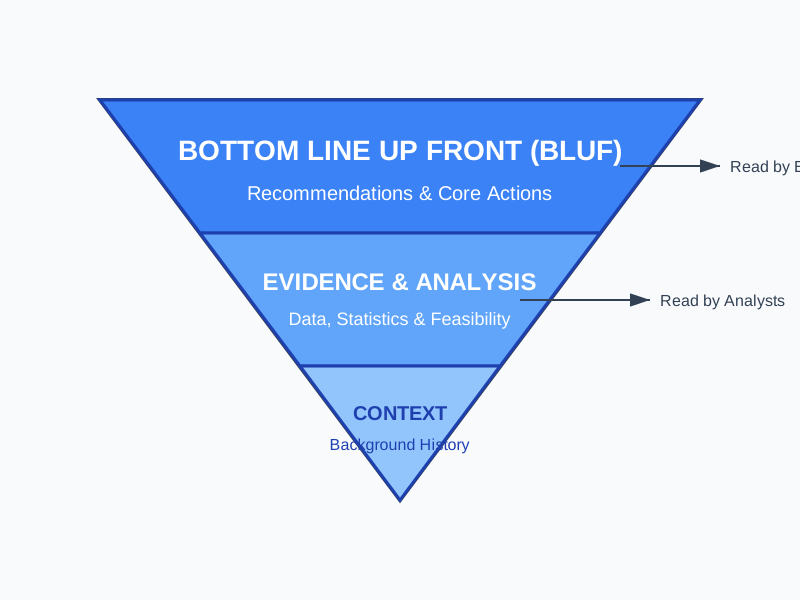
This format evolved from mid-20th-century government administration. Specifically, during the 1950s, organizations like the RAND Corporation pioneered systems analysis approaches that demanded "Bottom Line Up Front" (BLUF) communication for rapid, high-stakes decision-making. Decision-makers simply didn't have time to read a 20-page preamble; they needed the solution in the first paragraph. That tradition holds true today in every police department, courthouse, and legislative office in the country.
Most textbooks stop at the definition, but here is where the rubber meets the road. The nuanced difference that trips up most students is the audience. Your audience is not your professor. If you write your policy memo like an essay aimed at an academic, you will lose points. As MIT's Writing and Communication Center points out, a policy memo relies heavily on a targeted, deductive paragraph structure where the most important conclusions are presented immediately. You have to write it as if you are advising a busy, stressed-out police chief or state legislator who has exactly three minutes to understand why your solution won't get them sued or voted out of office.
Take the 2022 rollout of bail reform in various jurisdictions. The memos that successfully shaped local policies weren't 50-page theoretical treatises on the history of the cash bail system. They were crisp, 4-page documents that outlined the exact fiscal impact, the public safety risks, and the specific administrative steps required to implement the new rules. That is the level of precision your professor is looking for.
Read your thesis statement out loud. If it doesn't propose a specific action or solution, you are writing a research paper, not a policy paper. Rewrite it until it tells the reader exactly what they should do.
The History and Context of Policy Analysis
To truly understand what your professor is looking for, you have to understand why policy papers exist in the first place. Policy analysis in criminal justice became highly formalized following the 1967 President's Commission on Law Enforcement and Administration of Justice. This landmark commission heavily emphasized data-driven policy over purely reactive policing, fundamentally changing how governments approached crime. It marked the moment when criminal justice moved from being entirely reliant on the intuition of beat cops and politicians to being a field driven by empirical research and structured policy analysis.
By the 1990s, with the rise of the "tough on crime" era and sweeping legislation like the 1994 Crime Bill, the demand for concise, data-backed policy memos skyrocketed. Legislators and administrators needed quick digests of complex crime data to draft bills and allocate billions in funding. The memo became the ultimate currency of criminal justice administration. If you wanted to build a new prison, launch a community policing initiative, or secure federal grant money, you needed a bulletproof policy paper to justify the expense.
But the landscape is shifting again, and your writing needs to reflect that. Today, the focus is increasingly on criminal justice reform, decarceration, and equity. A 2023 survey by the Council of State Governments Justice Center highlights that modern policymakers demand proposals that specifically address economic feasibility and racial equity alongside public safety. You can no longer just say "hire more police" or "build more prisons" without a rigorous, data-driven cost-benefit analysis that accounts for unintended consequences.
I've seen countless students propose brilliant, utopian solutions that would cost billions of dollars to implement. In the real world, and on your grading rubric, ignoring economic feasibility is a massive red flag. Always address the cost.
Understanding this evolution is critical because it tells you exactly what your professor is grading you on. They want to see that you can navigate modern constraints—budget limits, public opinion, and legal precedent—not just summarize criminological theory. They want to see that you can think like an administrator, not just a student. When you frame your paper within the current reality of stretched municipal budgets and intense public scrutiny, your analysis immediately becomes more authoritative and compelling.
When policy papers stack up alongside weekly discussions, deciding to take my online class with professional support saves your semester, or go subject-specific and take my criminal justice class for me.
The 6-Part Criminal Justice Policy Paper Structure
If you're staring at a blank document, stop typing. Most students fail because they try to write a policy memo chronologically, treating it like a standard essay. Here is the exact 6-step framework you need to use, formatted precisely how your professor—and real-world decision-makers—expect to see it. This isn't just a suggestion; this is the industry standard format used in statehouses and police precincts across the country.
Step 1: The Executive Summary
Action: Write this LAST, but place it FIRST. The executive summary is a concise, 300 to 400-word digest of your entire paper. It must state the problem, outline the options you considered, and explicitly state your final recommendation.
Why this matters: In the professional world, this might be the only section a legislator or police chief reads. A National Institute of Justice (NIJ) communication guideline stresses that executives rely on these summaries to make million-dollar decisions within minutes. If your executive summary doesn't give them the answer immediately, they will toss the memo in the trash. The same goes for your professor grading a stack of 40 papers at midnight.
I've seen students waste this section on dramatic hooks or lengthy historical quotes. That is a guaranteed way to lose points. State the crisis, state the cost, and state the solution.
Do not use the executive summary to "hook" the reader or introduce broad criminological theories. Give away the ending immediately. Think of it as a spoiler-filled movie review.
Step 2: The Problem Statement
Action: Define a specific, measurable crisis. Do not write a paper trying to "solve mass incarceration" or "fix the war on drugs." Those topics are far too broad for a 10-page paper. Instead, focus on a quantifiable, hyper-local issue, such as "rising juvenile recidivism rates in Multnomah County over the last 24 months."
Why this matters: A policy cannot solve a problem that isn't clearly defined. According to 2023 data from the Bureau of Justice Statistics, hyper-local, community-specific interventions are exponentially more successful than sweeping state-wide mandates. Your professor wants to see that you can narrow your focus to a manageable scale.
When you define the problem, you must explicitly state who is affected, what it costs, and why the current approach is failing. If you cannot attach a dollar amount or a specific percentage to your problem statement, it is too vague.
Quantify your problem. If you say "drug use is increasing," you will lose points. If you say "fentanyl-related emergency responses have increased 42% since 2022, costing the city $2.1 million in overtime pay," you instantly command authority.
Step 3: Background and Context
Action: Provide only the essential history. Explain how the problem arose, but ruthlessly cut any history that doesn't directly impact your proposed solution.
Why this matters: Students often waste 500 words explaining the history of the criminal justice system dating back to the 1800s. The police chief already knows that. What they need to know is why the specific grant funding for your local diversion program dried up last year, or how a recent state supreme court ruling altered search and seizure protocols in your specific jurisdiction.
Here's what I see students get wrong every time: they confuse "context" with "filler." Every sentence in your background section should serve one purpose: proving that the status quo is unsustainable and that a new policy is desperately needed.
Step 4: Analysis of Policy Options
Action: Present 2-3 distinct ways to solve the problem. You must evaluate these options objectively using standard criteria: legal feasibility, economic viability, and political acceptability. You cannot just present one option; decision-makers need choices.
Take the famous "Boston Ceasefire" (Focused Deterrence) strategy from the 1990s. When analysts originally proposed it, they didn't just say "let's arrest gang members." They compared strict enforcement (high cost, high political resistance) against targeted social interventions combined with strict legal levers. They presented the options clearly so the mayor could weigh the risks and rewards.
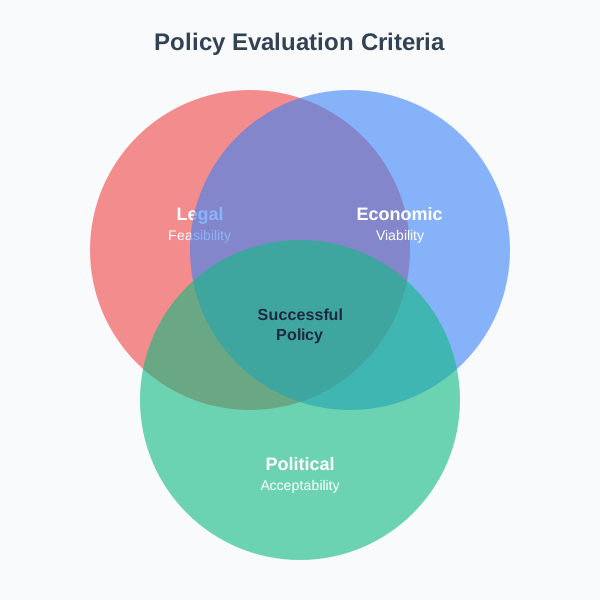
Your analysis should read like a comparative audit. Use subheadings for each option, and vigorously test them against real-world constraints. Will the police union block this? Will it require a tax hike? Is it constitutional under current case law?
Evaluating Policy Options Framework
| Evaluation Criteria | What It Measures | Why Professors Look For It |
|---|---|---|
| Economic Feasibility | Upfront costs, long-term savings, and funding sources. | Proves you understand municipal budget constraints and grant limitations. |
| Political Acceptability | Public opinion, stakeholder pushback, and media optics. | Shows you realize policy doesn't exist in a vacuum; even good ideas face backlash. |
| Legal/Administrative Constraints | Constitutional limits, union contracts, and existing statutes. | Demonstrates practical criminal justice knowledge and constitutional awareness. |
Step 5: Policy Recommendations
Action: Make a definitive choice and provide an implementation roadmap. Don't leave it up to the reader. Tell them exactly which option to choose and outline the specific steps required to implement it.
Why this matters: A policy paper without a firm recommendation is just a very stressful book report. State your recommendation boldly. For example, "Based on the cost-benefit analysis, Option B (Expanding Drug Treatment Courts) should be implemented within the next fiscal year."
Then, break down the "how." Who is responsible for implementing it? What is the timeline? How will success be measured at the 6-month and 12-month marks? A recommendation without an execution plan is just a wish. For instance, if you recommend a new mental health crisis response team, specify that the funds will be diverted from the existing patrol overtime budget, the training will take 90 days, and the key performance indicator (KPI) will be a 20% reduction in use-of-force incidents during mental health calls by the end of Q3. That level of detail guarantees an A.
Step 6: Conclusion and Implications
Action: Acknowledge the risks of your recommendation. Briefly summarize your argument, but spend the majority of the conclusion discussing the potential unintended consequences of your policy.
Why this matters: No policy is perfect. Every action creates a reaction in the criminal justice system. Admitting the limitations of your approach (e.g., "While this diversion program will drastically reduce recidivism, it requires an upfront budget increase of 15% in year one, necessitating the reallocation of funds from the traffic division") shows immense maturity and analytical depth. It proves to your professor that you aren't wearing rose-colored glasses.
Common Mistakes That Ruin Policy Papers
In my experience reading and analyzing hundreds of these memos, the difference between an 'A' and a 'C' rarely comes down to the quality of the research. It almost always comes down to tone, formatting, and a failure to understand the assignment. The textbook says to just "analyze the policy," but in practice, formatting is half the battle. Here is what I see students get wrong every single time.
1. Academic Jargon Overload
Students often try to sound "smart" by packing their memos with complex criminological theories like "differential association," "strain theory," or "anomie." Your audience isn't an academic; it's a practitioner. A 2024 survey of public administrators found that 78% of executives will stop reading a memo if it contains overly dense academic jargon in the first page.
The Fix: Write at an 11th-grade reading level. Use short sentences. Use bullet points. If you must reference a theory, explain it in plain English in one sentence and immediately tie it back to your specific problem.
2. Ignoring Counterarguments
If you propose implementing body-worn cameras for all police officers, and you fail to mention the massive data storage costs or the police union's privacy concerns, your paper will fail. You must anticipate the counterargument and address it directly. Policy exists in a highly contested political space.
Consider the Office of Justice Programs (.gov) evaluations of Drug Treatment Courts. The most successful policy memos advocating for these courts didn't pretend they were flawless; they explicitly acknowledged the high initial dropout rates but proved that the long-term cost savings in reduced jail beds outweighed those early failures.
Never assume everyone agrees with your premise. A strong policy paper builds a steel-man argument of the opposing side, and then dismantles it with superior data.
3. The "Objective vs. Subjective" Trap
Frankly, most textbooks fail to explain this clearly. You are writing an advocacy document, but you must maintain an objective, dispassionate tone. If your paper reads like an angry op-ed about a broken system, decision-makers will dismiss it as biased and emotional. You let the data do the yelling for you.
Academic Essay vs. Policy Memo Tone
| Feature | Academic Essay (What Not To Do) | Policy Memo (What To Do) |
|---|---|---|
| Primary Goal | To demonstrate knowledge of a theory and explore nuances. | To solve a specific, localized problem quickly and efficiently. |
| Language Style | Passive voice, complex vocabulary, theoretical explorations. | Active voice, concise, data-driven, direct directives. |
| Evidence Use | "Smith (2019) argues that systemic biases exist within the structure." | "2023 traffic stop data indicates a 14% disparity; Policy X resolves this." |
| Formatting | Long, flowing paragraphs with complex transitions. | Heavy use of bolding, bullet points, headers, and white space. |
The transition from writing essays to writing memos is one of the hardest adjustments for criminal justice students. You have been trained for years to expand your word count and explore every theoretical avenue. Now, your professor is asking you to condense complex, life-or-death civic issues into a tight, 5-page action plan. It feels unnatural at first. But once you master the framework, you realize it is actually much easier than writing a 20-page research paper.
Never say, "It is outrageous and unacceptable that so many youths are incarcerated." Instead say, "Incarcerating a youth costs the county $112,000 annually, with a 65% failure rate upon release." The numbers speak for themselves, and they are vastly more persuasive to a finance committee than your moral outrage.
How to Actually Write It: Study and Application Strategies
Now that you understand the 6-part framework, here is how to actually apply it without spending 40 hours in the library. Most students fail not because they don't understand the material, but because their writing process is deeply flawed.
The Reverse Outline Method
Never start by writing the introduction. Instead, write the final recommendation first. If your recommendation is "The city should implement a focused deterrence program," work backward. What options did you compare to arrive there? What background context makes this necessary? What is the specific problem statement? By outlining backward, you ensure every single paragraph in your paper drives toward your final conclusion.
The 10-Minute Executive Pitch
Before you write a single word, try to explain your policy paper out loud to a friend who isn't in your major, and limit yourself to 10 minutes. If you find yourself rambling about criminological theory instead of explaining the problem, the options, and the solution, you are not ready to write. This forces you to distill your argument into a true "Bottom Line Up Front" (BLUF) format.
Assignment Application and Time-Saving Hacks
When you sit down to draft, use headers aggressively. Your professor is looking for the structural markers. Do not bury your options analysis inside a massive block of text. Furthermore, don't waste time trying to find the perfect peer-reviewed journal article for every single point. Use government databases like the Bureau of Justice Statistics (.gov) to pull hard numbers quickly. Finding a stat that says "probation violations cost the county X dollars" takes 5 minutes and is ten times more effective than a lengthy quote from a textbook.
Always verify who the stated audience of the assignment is. If the rubric says "write a memo to the Chief of Police," and you spend two pages explaining police history, you've failed the audience test.
The Final Edit: Process Mistakes That Derail Policy Papers
We've discussed structural mistakes, but what about the errors made during the writing process itself? Based on grading rubrics and common complaints on r/AskAcademia, these process errors are silent killers.
1. The "N=1" Fallacy
Students frequently find one compelling anecdote—like a specific news story about a failed parolee—and treat it as a systemic issue warranting a massive policy shift. Policy cannot be based on a single data point. You must prove the anecdote is part of a larger trend using statistical evidence. If you can't find data to support the trend, it's not a policy problem; it's just a tragic event.
2. Falling in Love With the First Solution
Confirmation bias is rampant in policy writing. A student decides early on that "more body cameras" is the answer, and then they only research data that supports body cameras, completely ignoring the massive data storage costs and union pushback. A strong memo evaluates all realistic options objectively before making a recommendation.
3. Ignoring the "Do Nothing" Option
In the real world, the most common policy choice is maintaining the status quo. If you don't evaluate what happens if no action is taken (the baseline), your proposed solutions have nothing to be measured against. Sometimes, doing nothing is actually the most economically feasible option, and you must prove why the cost of inaction is higher than the cost of your proposed intervention.
Essential Resources for Criminal Justice Policy Writers
Stop relying on Wikipedia and outdated textbooks. To write a professional policy paper, you need to use the same databases that actual policy analysts use.
Free Government & Research Databases
- CrimeSolutions.gov: This is the holy grail. It is a clearinghouse run by the National Institute of Justice that rates criminal justice programs as "Effective," "Promising," or "No Effects" based on rigorous research.
- Bureau of Justice Statistics (BJS): Use this for your problem statements. It contains primary data on everything from arrest rates to corrections expenditures.
- The Campbell Collaboration: Excellent for finding systematic reviews of what actually works in crime and justice interventions.
Professional Organizations
Citing reports from the American Society of Criminology (ASC) or the Police Executive Research Forum (PERF) adds instant credibility to your policy options analysis. These organizations publish guidelines that practitioners actually use.
Need More Help?
If you're still staring at a blank screen and feeling completely overwhelmed by your coursework, we can help. The experts at Pay Someone To Take Online Class don't just handle math—we provide comprehensive academic support, helping you structure complex policy memos, analyze data, and guarantee you pass your online classes with confidence.
Conclusion: Your Next Steps
You started this article staring at a blank screen, terrified that your standard academic essay approach wouldn't work for a policy memo. Now, you have the exact 6-part framework used by professional analysts to drive real-world change.
Here is what you need to remember:
- BLUF is Law: Put your Bottom Line Up Front in the executive summary.
- Quantify the Crisis: Define your problem statement with specific dollar amounts or percentages.
- Evaluate Objectively: Compare multiple options against legal, economic, and political constraints.
- Ditch the Jargon: Write for a busy executive, not a theoretical academic.
You've got this. Writing a policy memo feels unnatural at first, but it is one of the most valuable skills you will learn. According to 2026 BLS data, First-Line Supervisors of Police and Detectives command a median salary of $105,980, and Emergency Management Directors earn over $86,000. To reach those leadership positions, you have to know how to write a compelling, data-driven policy memo.
Here's your next step: Tonight, write your specific, quantified problem statement. Don't worry about the rest of the paper yet. Just define the crisis. And if you find yourself stuck, reach out to our expert team for targeted, professional academic assistance.